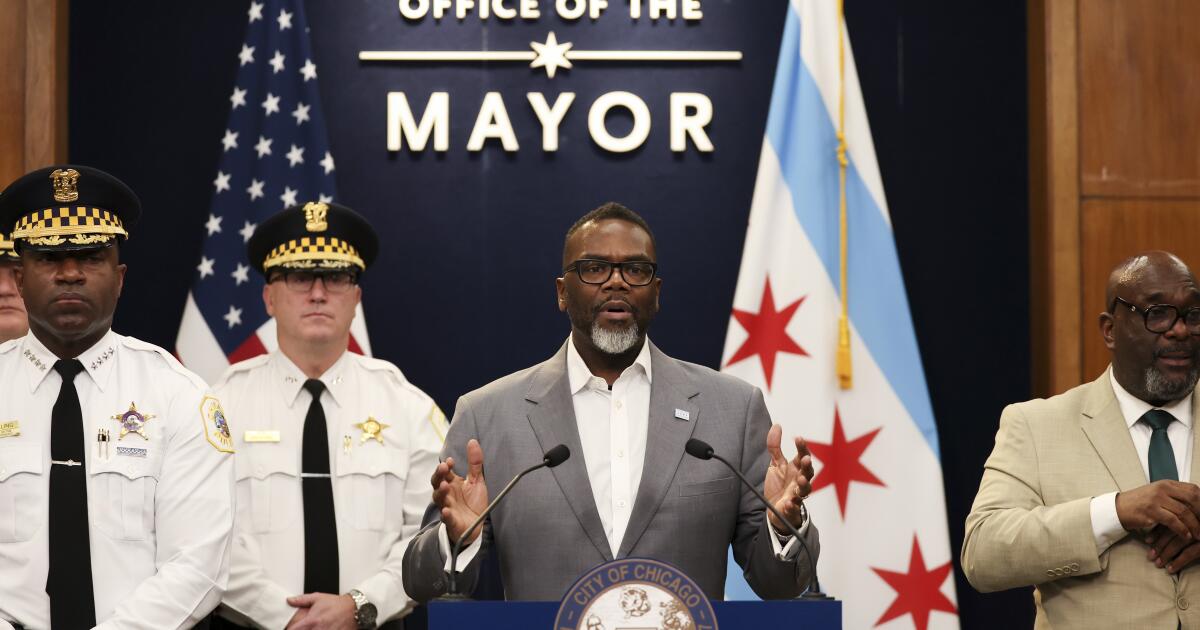
Mayors Unite Against Trump’s Crime Narrative: Highlighting Urban Progress Amid Federal Intervention
Title: Black Mayors Unite Against Trump’s Crime Narrative Amid Federal Intervention
By [Your Name]
In a bold response to President Trump’s recent declaration of Washington, D.C., as a “crime-ridden wasteland,” mayors from cities led by Black leaders are banding together to challenge the narrative that their urban areas are plagued by rampant violence. This comes as the president threatens similar federal interventions in other cities, including Baltimore, Chicago, and Los Angeles, all of which are under Black leadership.
Last week, Trump announced the deployment of 800 National Guard members to the nation’s capital, citing a need for federal law enforcement to address crime. However, many mayors argue that this characterization is misleading and fails to reflect the significant declines in violent crime their cities have experienced since the pandemic.
Van Johnson, the mayor of Savannah, Georgia, and president of the African American Mayors Association, emphasized the need to amplify their voices against what he calls “rhetoric that crime is just running rampant.” He stated, “It’s just not true. It’s not supported by any evidence or statistics whatsoever.”
Statistics from Washington’s Metropolitan Police Department reveal a drop in violent crime since a peak in 2023, contradicting Trump’s claims. Chicago Mayor Brandon Johnson highlighted his city’s “historic progress,” reporting a more than 30% decrease in homicides and nearly 40% in shootings over the past year. Similarly, Los Angeles Mayor Karen Bass noted a 14% reduction in homicides, calling the federal intervention a “performative power grab.”
In Baltimore, Mayor Brandon Scott pointed to a Comprehensive Violence Prevention Plan initiated in 2021, which has led to historic decreases in homicides and nonfatal shootings. He accused Trump of exploiting crime as a “wedge issue” rather than genuinely seeking solutions to violence.
Oakland’s Mayor Barbara Lee reported a 21% drop in homicides and a 29% decrease in all violent crime in the first half of 2024. She dismissed Trump’s comments as “fearmongering,” asserting that community-driven initiatives are yielding positive results.
Community advocates echo these sentiments, arguing that the progress made in reducing crime is largely due to grassroots efforts. Nicole Lee, executive director of the Urban Peace Movement in Oakland, stressed the importance of community partnerships in fostering safety, warning that military intervention could undermine these advancements.
As federal agents patrol the streets of Washington, D.C., mayors like Johnson are advocating for federal support in areas such as gun trafficking and cybercrime, rather than military presence. “There is a different skill set that is used for municipal law enforcement agencies than the military,” he noted.
The mayors are closely observing how D.C. Mayor Muriel Bowser navigates this unprecedented federal intervention. Johnson praised her for maintaining dignity and grace amid the turmoil, stating, “Black mayors are resilient. We are intrinsically children of struggle.”
As the situation unfolds, these mayors remain committed to showcasing their cities’ successes and challenging the narrative that seeks to undermine their achievements. “We will continue to closely work with our regional federal law enforcement agencies,” Scott affirmed, vowing to push forward despite the obstacles posed by the current administration.
In a time of heightened tension and scrutiny, the collective voices of these mayors serve as a powerful reminder that progress is being made in urban America, even as political narratives threaten to overshadow it.


